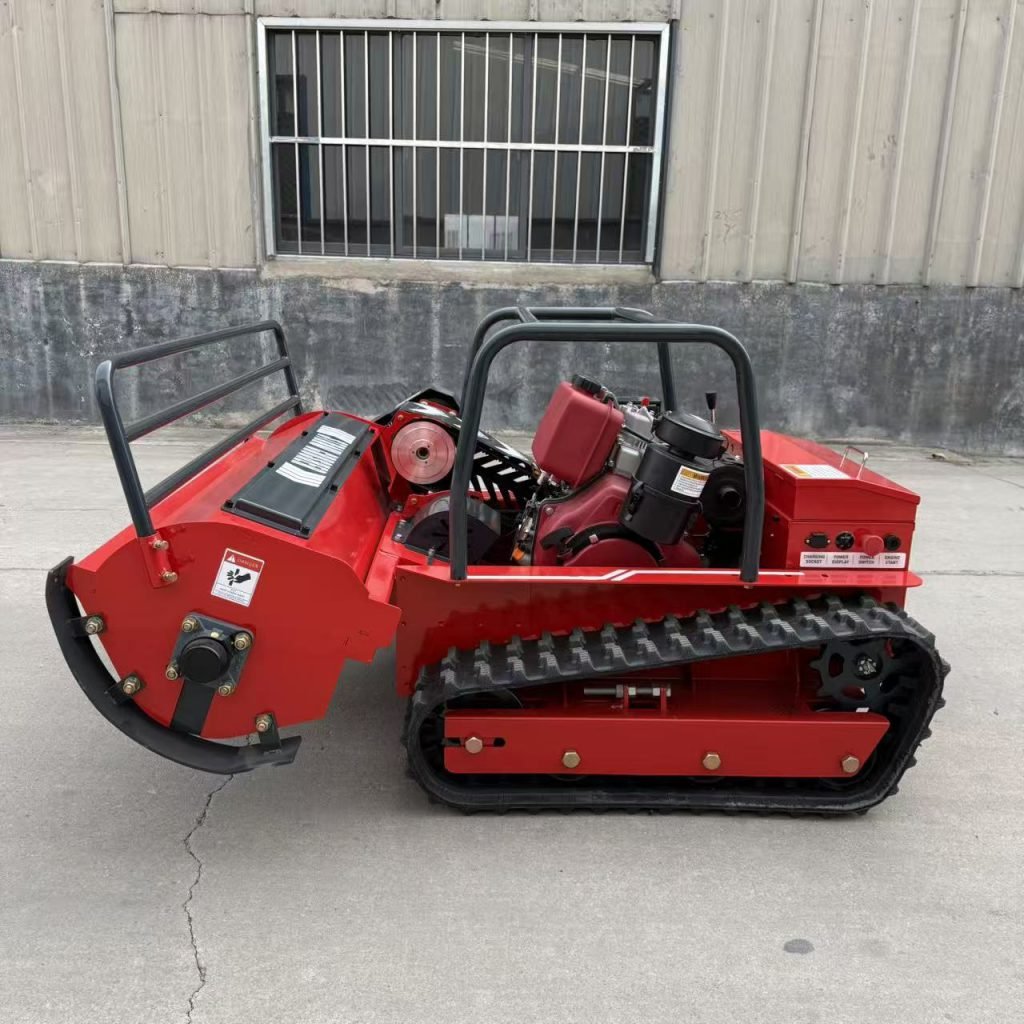
Remote-controlled tracked mowers moved from a curiosity to a normal purchase line on a lot of properties in the last few years. The reason is not that the remote is convenient. It is that the machine goes places a person on a seat cannot go safely.
Where an RC mower clearly wins
- Slopes. Anything over roughly 20 degrees is where a ride-on becomes a rollover conversation. A low-centre-of-gravity rubber-tracked unit with a flail deck cuts bank ditches, roadside embankments, orchard berms and dam walls while the operator stands on flat ground.
- Orchard and vineyard rows. A narrow tracked body with a wide deck runs under low tree canopies and between posts where a tractor and brush hog cannot fit, and cuts the whole alley in one pass.
- Unknown ground. Hidden stumps, holes, brambles, rocky scrub, standing water with who-knows-under-it. On an RC machine the risk falls on a bolt-on undercarriage instead of on a person.
- Hot, humid or dusty long shifts. Operator fatigue causes a large share of landscape equipment injuries. A walk-behind with a remote is physically easier to run for six hours than a seat in a cab in 35 degree heat.
Flail versus flail-hog versus rotary: pick the right deck
Flail decks use hinged free-swinging Y- or T-blades on a rotating drum. They tolerate hitting rock, stump and wire far better than a fixed-blade rotary, mulch finely, and throw little debris because the cutting happens inside a closed chamber. They also self-level over uneven ground better than a rigid rotary deck. The tradeoff is slightly lower peak throughput in tall, uniform grass.
Fixed-blade rotary / brush hog cuts faster in clean, tall grass and handles heavier woody brush at a given horsepower, but a struck object travels up the blade into the deck and the drivetrain — and a rotating blade near a person is a genuine hazard.
For mixed terrain, orchards, and anything with debris, flail.
The specification numbers that matter
- Cutting width versus your row spacing and gate widths. Many units offer a hydraulic offset or swing arm to reach along fences.
- Cutting height range and whether it is adjustable under load.
- Max slope rating — note whether the quoted figure is side-slope or front-to-back, they are different.
- Ground pressure, which is what lets it work soft soil without leaving ruts.
- Maximum material diameter the flail will actually handle without wrapping, not just the brush rating.
- Remote range and whether it fails safe on signal loss. It should stop, not run.
- Fuel and runtime per tank, and the service interval on the track and final drives.
What it will not solve
An RC mower is slower per hectare than a tractor-mounted hog on big flat clean acreage. It cannot run in frost-hard conditions that hurt the operator equally. And if you have 200 ha of level pasture, a ride-on is the right tool.
The economics work out on properties that are steep, obstructed, orchard-type, or where the alternative is a person with a brush cutter — which is exactly the operation the machines were designed to replace. Hand-held strimmer work is one of the higher-injury categories in land management, and a day of it on a hot slope costs you in compensation, fatigue and turnover.
Buying used or imported
Check the drum bearings for play, look at the chamber liner and the flail-blade wear, verify the remote pairs to the machine and that the emergency stop kills the deck, and confirm the engine’s emissions certification for your market. Track pitch wear is the expensive item to discover late.
Our remote-control tracked flail mowers are built for exactly this work, with adjustable cutting height, hydraulic deck offset and rubber tracks for low ground pressure. Tell us your slope angles, row widths and typical material and we will size the deck and engine to it.