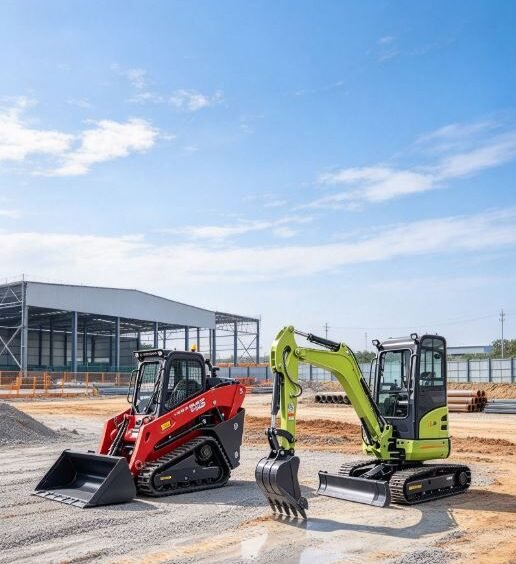
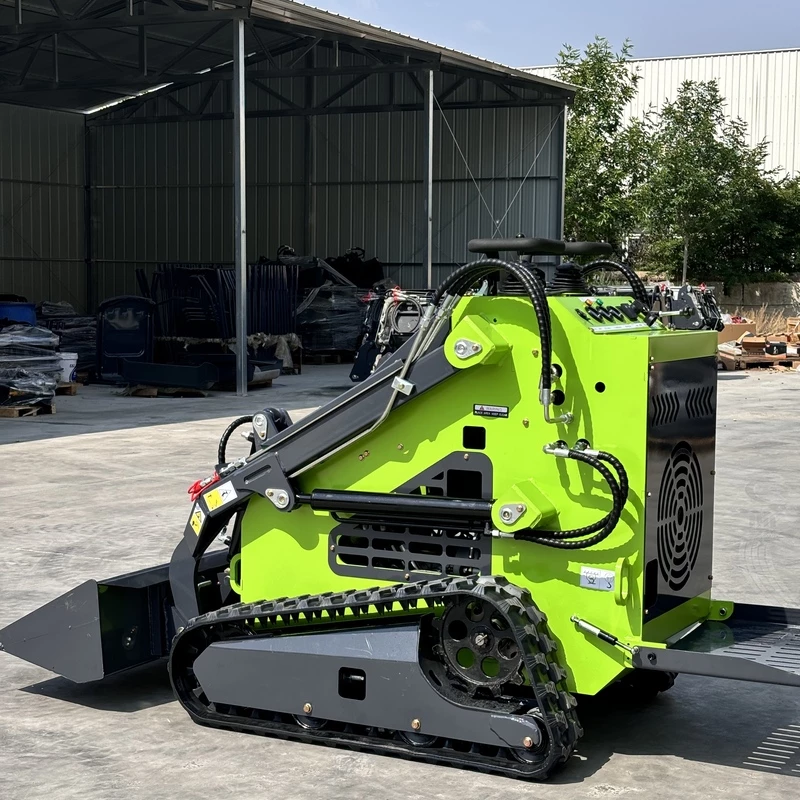
Rubber tracks are the most misunderstood wear item on a compact track loader. Contractors routinely get three or four years out of them and then replace them twice as fast because of a handful of habits that are entirely avoidable.
Get the tension right, and check it weekly
Both too loose and too tight destroy tracks, in different ways.
- Too loose: the track squirms laterally, the pad delaminates at the edge, and on a hard turn the track can slip off the roller entirely. De-tacking bends the carcass cords and is a death sentence, even if it looks fine after you re-track it.
- Too tight: constant tension on the cords, overheated undercarriage, accelerated wear at the sprocket teeth, and a hard ride that transfers shock into the frame.
Consult your manual for the specific deflection spec. The common field check: on the ground, with the machine’s weight on the track, grip the track at the middle of the idler-to-sprocket run and see how many fingers fit between the track and the roller. Most compact track loaders want a small, consistent gap on both sides — and both sides must match, or you are running skewed.
Clean it, especially out of season
Packed mud and concrete splatter are the two big ones.
- Wet concrete in a track carcass sets, becomes a hard lump, and tears the pad off the next time it flexes. Wash it out the same day, every time.
- Packed mud freezes in winter, which turns the undercarriage into a rigid block and cracks the rubber. Blow it out before storage.
- Do not pressure-wash directly at seals, idlers and the track joint. Use a low-pressure rinse or a wand at distance and let a scraper do the work.
Inspect the whole undercarriage, not just the rubber
Bad rollers and idlers will wear out good tracks. Walk the machine every few hundred hours:
- Idlers and rollers — spin them by hand with the machine lifted. They should turn freely with no grinding or wobble. Any seized roller polishes the track lining from the inside.
- Sprockets — look for hooked, worn or chipped teeth. A worn sprocket does not mesh correctly and pulls at the cords. Replace sprockets in pairs, and never install new track on badly worn sprockets.
- Track lining and bar tops — check for wear, cuts and the exposed-cord zone. Small cuts can be sealed before they let water into the carcass, and water in a steel-cord track means internal rust from the inside out.
- Track gauge — measure the width across both tracks. Different readings indicate damage to the frame or a bent roller bracket, not just the track.
The operating habits that shorten life most
- Traveling on paved road rather than flat dirt or gravel between jobs. The abrasion is severe. Take the trailer for anything over a few hundred metres.
- Skid-steering on asphalt, concrete or hard-packed gravel, especially with a loaded bucket pushing down on one corner.
- Spinning the tracks to break out of a bog instead of digging out and ramping up.
- Carrying a load so heavy that the rear rollers walk on the very edge of the track.
- Using the tracks as a bulldozer blade to push piles sideways.
Storage
Clean, dry, out of direct sunlight, and off a hot surface. UV and ozone crack the sidewalls of a track that sits in a yard all summer. Park it so the machine’s weight is not resting on a single flat spot for months, and do not store it on the tracks in a puddle.
Log it
Track hours, tension readings, replacements, and sprocket changes. If you run more than one machine this is how you spot an operator or a site that is chewing through inventory.
Send us your ground conditions and duty cycle and we will recommend the track pattern, width and undercarriage package for your machine rather than the generic one.